
beautyme collections culture cuisine motor music search
 Unknown
Amazon
Unknown
Amazon
Culture in nature in ancient Brazil
25 October 2001 - 1 April 2002 Joseph
Hotung Great Court Gallery A
www.british-museum.ac.uk
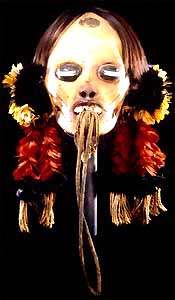
fig.: Mundurucu Trophy Head, trophy heads were taken in war by the Mundurucu and prominently displayed as proof of a warrior's prowess, H: 17, W: 23, L: 20 cm. © The British Museum.
Unknown Amazon at The British Museum is the first major exhibition to address the great antiquity and complexity of tropical forest civilisation in the Amazon Basin. Organised in association with BrasilConnects, over 200 objects from a wide range of Brazilian and European collections will be brought together for the first time to reflect an Amazonian way of knowing the world and to bring to life the long history of human occupation in this vast region.
Prevailing
preconceptions have tended to minimise the cultural achievements of
Amazonian civilisations that flourished long before European contact
with the Americas. Based on the latest archaeological and ethnographic research, the exhibition reveals highly
sophisticated cultures with powerful artistic traditions. Some of the very first objects collected
by European travellers
are presented alongside contemporary artefacts to illuminate Pan-Amazonian
cultural patterns
revolving around tropical forest subsistence practices, shamanism and
warfare.
Unknown Amazon includes spectacular polychrome funerary urns from the Marajoara culture - amongst the finest ceramic masterpieces from the tropical forest lowlands; exquisite Santarém stone amulets fashioned from nephrite, jadeite and quartz carved in the shape of fish, toads and frogs; a shimmering scarlet macaw and hummingbird feather labret (mouth decoration) worn during the name-giving ceremonies of the Urubu-kaapor tribe; a full set of brilliant featherwork used in the war rituals celebrated by the Mundurucu tribe and collected by the Austrian naturalist Johann Natterer; trophy heads, war clubs and shamanic objects are complemented by basketry, skilfully woven hammocks and beaded tangas (loincloths). What emerges is a striking picture of densely populated societies thriving long before European contact with rich artistic traditions executed in pottery, stone, wood and feather work. These new insights have a vital role to play in opening up new perspectives on planning and decision making for the future of the Amazon.
Unknown
Amazon is accompanied by a full programme of public and educational
events and a beautifully illustrated collection of essays Unknown Amazon: Culture
in nature in ancient Brazil,
edited by Colin McEwan, Cristiana Barreto and Eduardo Neves.
 RSS Feed